
Educational Liberties and Safety Unit (ELSU):
A School Safety Intervention, Response, and Support System
Daisia Murray
The City College of New York
ENGL 21007
Brandon Borocoman
June 29, 2026
New York City’s public school system faces an abundance of obstacles such as student behavior, student attendance, and school safety, mainly in high-risk areas, specifically the Bronx. According to “NYC school Bullying Up 146% Since 2019: DiNapoli report”, the article mentions that a NYC school survey was conducted and found that 51% of NYC students had reported harassing, bullying, or intimidating between each other in their school. The learning environment in Bronx, NY dampens a student’s development and academic standing, this is due to the various factors; high absences, bullying, drug use, violence, and classroom interruptions. Although there is a school safety system in place in NYC schools according to “Violent and Disruptive Incidents and Bullying in New York Schools”, the Safe Schools Against Violence in Education (SAVE) identifies issues of school safety and violence prevention, but there still is room for improvement. In addition, teachers are feeling stressed and burnout, this adds to the staff shortage and declines the education outreach for students.
Background
The problem in NYC highschools consist of high rates in absences, a decrease in academics and student motivation, a disconnect between staff and students,
- The Problem in NYC High Schools: 1) High rates of absences 2) students skipping class/ school 3) decrease in academics and student motivation 4) the disconnect between staff and students
- Safety Concerns and Student Behavior: 1) bullying in school and online 2) fights and classroom behavior 3) possession of weapons in school 4) drug and vape use in school bathrooms and classrooms 5) mental health in students, especially depression and suicide risk 6) staff disrespect
- Effect on Staff: 1) teacher burnout and stress 2) mental health causing teach to quit or other high risk outcomes
- Limitations of the Current System: 1) current DOE policies focus more on punishment than preventing these situations 2) no consistency in enforcing attendance and behavior policies 3) the past truancy unit existed but were later replaced with school-based officials who didn’t discipline students 4) current reporting website expects student/teachers/parents to put their information before making a report
- Reason for Educational Liberties and Safety Unit (ELSU): 1) reinstate truancy patrol 2) support school staff 3) add more counseling, outreach, and attendance involvement for students
Proposal Statement
The proposal will suggest the creation of the NYCDOE’s Educational Liberties and Safety Unit (ELSU). This system will be an organized unit to improve the school environment, diminish truancy, support high risk and low risk students, and help staff in upholding a safe and effective learning environment. The system will focus on all Bronx high schools, with the Bronx ranking as the worst public school system in NYC, and with future goals of expanding throughout all boroughs and other grades such as middle school. This proposal will outline the background of NYC’s public school system, explain the responsibilities of ELSU, and talk about the procedures and methods. This proposal will not replace existing school staff but add more ELSU staff to help with the student ratio in Bronx high schools.
Technical Description
System Overview
The main purpose of ELSU is to decrease school violence, bullying, and improve the school and educational environments. The system is meant to identify visible and hidden student safety risks. ELSU does not only respond to bad behavior but detects any unsafe incidents early and supports students who are quiet or afraid to report these problems. ELSU responds quickly to any school safety accidents and organizes interventions that resolve immediate accidents and the background cause of said accident.
ELSU has 5 main functions: incident reporting, risk assessment, intervention, case monitoring, and the performance assessment. These functions allow the system to collect information, evaluate the risk levels for each case, implement the right staff needed for these incidents, and track the outcomes over time.
System Components
The ELSU system is made up of agents/staff, technology, and support programs to help students and teachers within the Bronx high schools. The staff / agents include ELSU Safety Officers, Guidance Counselors, Social Workers, Mental Health Professionals, Coders, Data Analysts, and School Administrators. The technology component consists of an incident reporting platform, a student case management, school safety dashboard, and a secure communication system. These technologies allow any information to be collected, organized, evaluated, and shared through authorized staff in ELSU. Support program components consist of a Violence Prevention Program, Bullying Prevention Program, Student Mental Health Support Program, and each program also supports silent victims who do not report but show a distinct sign of distress.
Physical Infrastructure
ELSU would operate from a Bronx headquarters that is meant to be the system’s base. This headquarters will contain administrative offices, meeting areas, training rooms, and a monitoring space for data. Participating schools would contain ELSU offices, counseling rooms, and mediation rooms where students are able to meet agents and receive the support they need. The system needs computers, tablets, secure and updated servers, communication devices such as walkie talkies or cellphones, and responsible vehicles funded by the Department of Education to support daily responsibilities and out field tasks.
System Inputs
The ELSU heavily relies on the active inputs from students and teachers to identify and respond to unsafe situations. The active input are reports that involve bullying, fights, threats, possession of a weapon, drug use, and other violations. To add on, inputs include attendance records, disciplinary records, previous school records, parent complaints, administrator requests, teacher referrals.
The ELSU relies on passive inputs from students and teachers that are hesitant to speak out publicly. The passive inputs are reports that involve anonymous reports from students and teachers, detection of behavior changes such as in-class disengagement and isolation from others, absenteeism, observations of physical and emotional distress from teachers and students. The inputs also consist of student education and disciplinary history, attendance records, any past mediation sessions, and the overall school safety data trends.
System Outputs
The end results will consist of the reduction of violence, bullying, and an improved school safety system. Student’s ability to report incidents will increase, silent victims will feel seen and safe by having an outlet without feeling the need to speak out publicly, overall mental health cases amongst students and even teachers will improve, the connection between student and staff will also improve, allowing trust between the two.
User Interaction
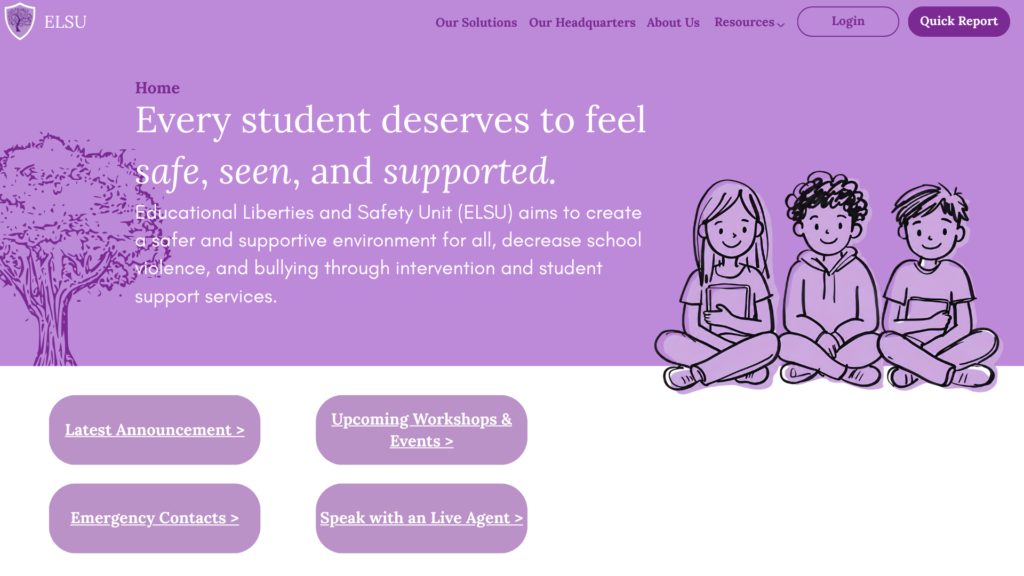
Figure 1. ELSU Homepage
Students: Students interact with the system by submitting incident or anonymous safety reports via the ELSU database website, they are able to access their own case files, participate in counseling, and request help without fear of punishment.
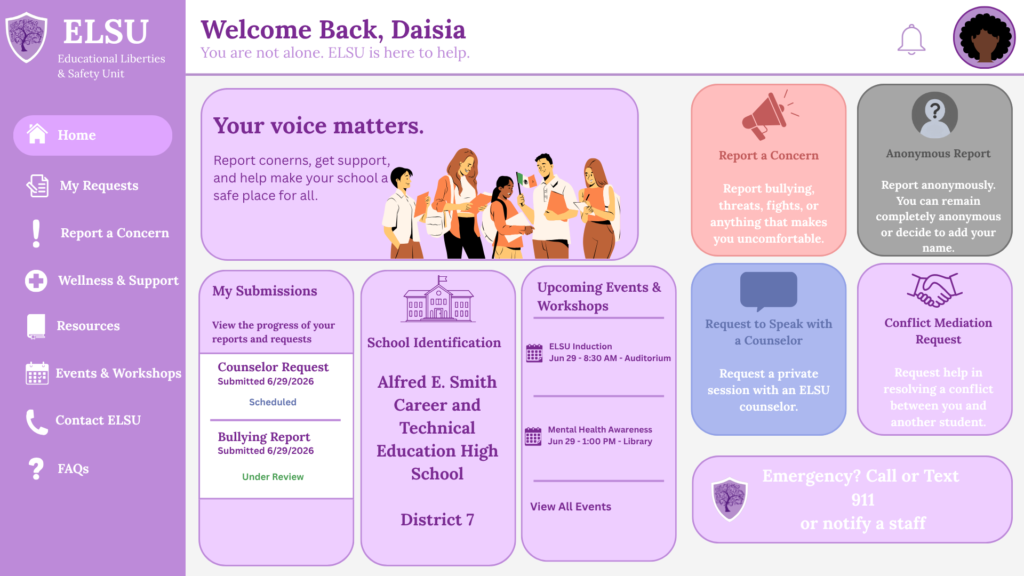
Figure 2. ELSU Student Portal
Teachers: Teachers interact with this system by reporting incidents or behavior concerns, identify silent students showing distress, and request ELSU support services for themselves or a student.
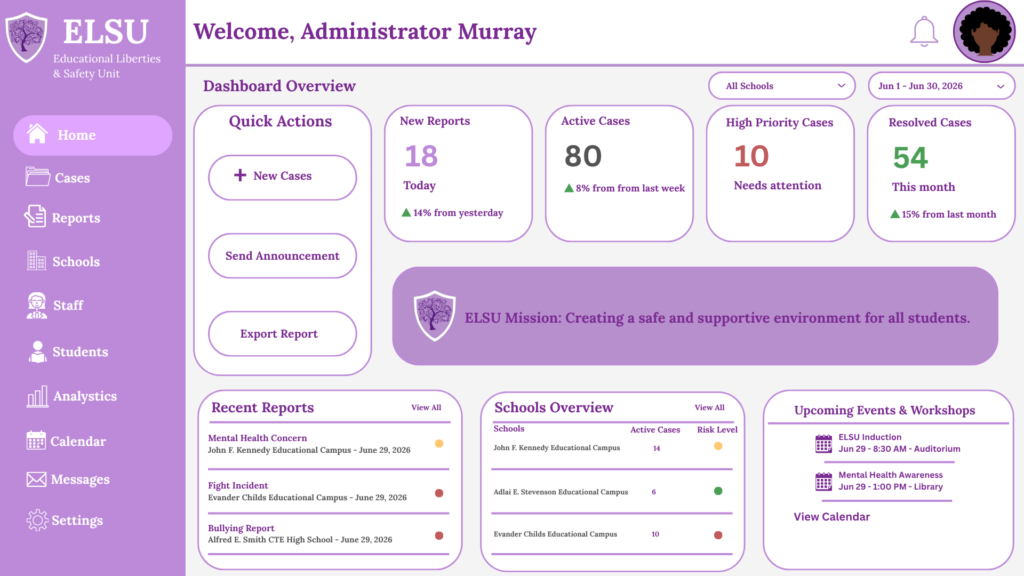
Figure 3. ELSU Admin Portal
Parents: Parents interact with this system by receiving updates on interventions, participating in ELSU meetings with the public, and submitting reports about their child’s safety or a concern with a staff member.
School Administrators: School admins interact with this system by monitoring the dashboard, approving intervention request forms, and coordinating with ELSU staff members.
ELSU Staff: ELSU staff interact with this system by reviewing and investigating cases, conduct interventions, monitor resolved cases over time, update case records, and coordinate with existing safety officers.
System Data Flow
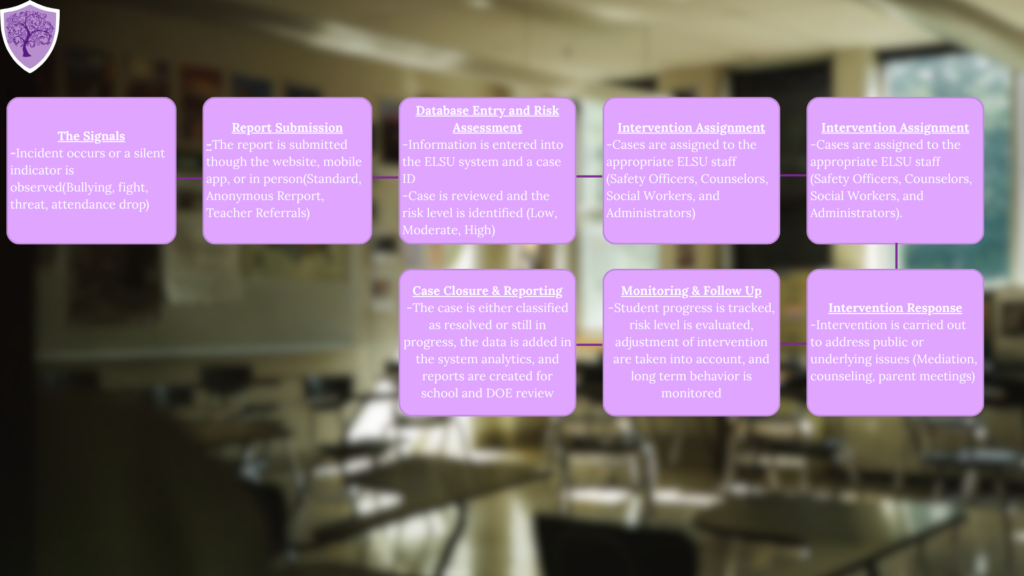
Figure 4. ELSU System Flowchart
Maintenance
ELSU agents are obligated to do an annual crisis response training, mental health and trauma response training, and conflict resolution certification. For technology maintenance, weekly database updates and upgrades, system backup recovery, cybersecurity monitoring, and device upgrades. For the overall operational maintenance, ELSU staff need to conduct monthly system audits, policy assessments, review budget and resources, and then end of the year program analysis.
Costs, Materials, Labor, and Timeline
Materials
The materials that will be used are office furniture, computers, tablets, communication devices such as walkie talkies or cellphones, response vehicles, secure servers, and office supplies such as organizer cabinets for physical documents etc.
Labor
The staff needed is an ELSU Director, ELSU Safety Officers, Counselors, Social Workers, Administrative Assistants, Data Analysts, and Trainers.
Estimated Costs
The estimated first year cost would be about 15 million due to staff costs, infrastructure and technology, maintenance, and system assessment.
Staff Costs: ~9.5 million
Infrastructure and Technology: ~4 million
Maintenance and Software Support: ~1 million
System Assessment and Research: ~500,000
Timeline
The overall timeline should be about a year for the whole operation to run smoothly.
Month 1-3 would be the planning phase which would consist of purchasing equipment, developing the software and hiring a leader role
Month 4-6 would be the training phase, the director would hire staff, start the training process, and the orientation for all hired staff
Month 7-9 would be the trial run, the operations would start in participating Bronx high schools, the reporting system would be tested, and data would be collected throughout the trial run.
Month 10-12 would the evaluation phase, the end performance from the trial run will be reviewed, improvements will be made, and a discussion of future expansion
Results, Significance, and Desired Outcomes
Expected Results
The end results of the Educational Liberties and Safety Unit (ELSU) will consist of the reduction of school violence, bullying, and an improved school safety system. Through faster intervention and staff involvement, there will be better support for all students, including silent students. In addition, the student trust between school officials and students will increase, the teacher morale will increase, and the attendance will improve.
Significance
This proposal is important because it supports physical and mental safety for students and staff. By preventing problems before they escalate it creates a more calculated and structured school safety system. The ELSU is a good model for other boroughs in NYC.
Long-Term Outcomes
ELSU hopes to expand to Brooklyn, Queens, Manhattan and overall citywide. By developing more digital tools that cater to this generation, this will improve the DOE safety policy over time.
Conclusion
The Educational Liberties and Safety Unit (ELSU) is a structured school safety system created to improve the school environment and address visible and hidden reports for the student’s physical and mental health. With structured interventions, monitoring data, and creating a school support system, ELSU aims to create a safe and supportive environment in Bronx high schools, and a future expansion across all NYC high schools. For further discussion and questions, you can connect with me through my email, [email protected]. Thank you so much for taking the time to read through my vision for school safety in NYC.
AI Acknowledgement
Google Gemini and ChatGPT were used to find articles for research and structure ideas.
References
Antin, J. S. (2026, April 25). NYC school Bullying Up 146% Since 2019: DiNapoli report | AEE Law. NYC School Bullying Up 146% Since 2019: DiNapoli Report. https://aeelaw.com/insights/nyc-school-bullying-dinapoli-report-2026/
Dinapoli, T. P. (n.d.). New York State School Safety: A statewide and regional … Violent and Disruptive Incidents and Bullying in New York Schools. https://www.osc.ny.gov/files/local-government/publications/pdf/nys-school-safety-statewide-regional-review.pdf

This entry is licensed under a Creative Commons Attribution-NonCommercial-ShareAlike 4.0 International license.

